
Showing posts with label David Copperfield. Show all posts
Showing posts with label David Copperfield. Show all posts
Wednesday, November 28, 2012
A Vist to the Bahamian Island of David Copperfield

Saturday, November 3, 2012
P is for Part 3

Approbation has been conflated with page views.
Real performance is a bi-directional process in real time, a conversation really between the magician and his audience. And, like any conversation, it is made up of an unending series of adjustments and refinements in response to verbal and non-verbal cues passing back and forth over the footlights.
There is no virtual simulation for this, no matter how good your Internet connection.
To upgrade your skills as a performer, you have to perform in front of a living audience.
Preparing for those performance opportunities means doing what other performance artists have always done: prepare, practice and rehearse.
I can recall my own early days in magic and how each time I would get a new trick, I would renew my commitment to being a better performer only to tear open the package, pour over the instructions and quickly become bored with the props. And, like most game day prayers, my commitment to practicing would similarly evaporate.
It was only when challenged to "do a trick" that I would go back to my props and quickly try to put together a program based on my sketchy memory of the instructions I had read. It's no surprise then that I never accomplished my goals in magic.

By reputation, Burger is one of magic's revered philosopher kings. He is as comfortable discussing theory and history as he is performing his torture-themed take on the Card Warp.
What is less clear until you see him in person is the mischievous twinkle in his eye. He clearly enjoys confounding his audiences. In my notebook I wrote "The Friar Tuck of Magic."
The premise of his lecture was "how can we make our shows better?" Not how can we be better magicians, or how can we master a particular aspect of presentation, but how can we make our shows better. How do magicians make better theatre?
In answer to his question, Mr. Burger went on to define what he felt were the four pillars of a good show.
Pillar I: Practice
Burger is an advocate of regular and conscious practice.
While I can't pretend to speak for all, it seems that, for many, practice is too much like dieting: they know they need to do it, but something more interesting always seems to get in the way.
It is for this reason that so many effects are sold as being "easy" and requiring little to no skill.
While I am certain it happens all the time, I am pretty sure Burger would maintain it was a mistake to confuse the skill requirement with the mandate to practice. It may not take a lot of skill to operate a Svengali Deck, but it does take practice.
One of the key reasons for practicing is to empower the performer to not have to think about the procedure of the effect. In Burger's words, "thinking kills magic."
Burger went on to say that practice should also be conscious. This is to say that in practice the moves should be second nature to the performer but they should never be automatic. The performer needs to pay attention to their practice so as not to learn bad habits. The last thing one wants is to invest hours and hours perfecting a piece of "sneaky business" only to have it not be right for a particular effect.
Pillar II: Rehearsal
Burger differentiated practice from rehearsal by saying that while practice can and should be done alone and in front of a mirror, rehearsal should be done in front of a camera and, as in the theatre, attempt to replicate as closely as possible actual show conditions. And, Burger was careful to caution, it would serve the performer well to not always assume that the rehearsal audience is nice, or even interested in his magic.
The camera can be a useful tool for identifying procedural and presentational shortcomings but, like the Internet video performances of so many young magicians, it can blind the performer to angle issues that can crop up in the real world. To receive maximum benefit from these rehearsals, the performer should move the camera to less-than-ideal angles.
Pillar III: Scripting
Like practicing, magicians have heard about scripting their effects, but it too often falls off the preparation checklist.
Too many performers, especially beginners who specialize presenting other people's magic, believe that by repeating the presentation of the person who demonstrated the effect to them they will be "real magicians." Worse, there are far too many who believe, mistakenly, that they have superior improvisational skills and they simply make up their presentation as they go along.
Burger's position is that a magic trick is a "picture without a frame" and it is through the scripting process that the performer provides a context for the effect.
It should be noted here that the script for a given effect has to also be consistent with the performer's onstage character. This comes back to the magician as actor playing the part of a magician notion of Robert-Houdin.
Presuming I could master the Card Warp effect, it would no more make sense for me to repeat Burger's script than it would for David Copperfield to perform the endurance stunts of David Blaine. Scripting is how the performer makes a particular effect part of their particular show.
And, from a purely technical perspective, the structure of a script provides the performer with a way of avoiding cluttering up the audience's experience of an effect with unnecessary verbiage--what Burger calls "verbal lint." Improvisation can add energy to a performance, but the uncertainty can lead the performer--especially an inexperienced performer--to a dead end the only way out of which is more words and more audience confusion.
Pillar IV: Critique
By investing in the first three pillars--practice, rehearsal and scripting--the performer should be more than ready to accept the feedback of a constructive critique. Soliciting the comments of trusted fellow magicians and civilians, the performer can continue to adjust and correct aspects of their show so that they can be ready for an audience.
ByThe processes that Burger described are not static. Much like then final performance, the process is bi-directional with each refinement impacting practice, scripting and rehearsal. Each critique, like each, performance, informs the scripting, rehearsal and so on.
Burger's Pillars are foundational to the creation of strong, individual performance and essential to beginning a real conversation with the audience.
Sunday, November 13, 2011
"...But Is It Art?"
We have learned to whittle the Eden Tree to the shape of a surplice-peg,That is Kipling. It's from a poem called the Conundrum of the Workshops.
We have learned to bottle our parents twain in the yolk of an addled egg,
We know that the tail must wag the dog, for the horse is drawn by the cart;
But the Devil whoops, as he whooped of old: "It's clever, but is it Art ?"
I don't know a lot of Kipling. I know that he wrote probably the best tribute to the heartbreak of losing a dog. I know also that he wrote the story that became one of my favorite John Huston films, "The Man Who Would Be King."
I was reminded Kipling as I read this essay by Jamy Ian Swiss. Swiss is a working magician and author of some of the best book reviews I have read on magic, or any other topic.
Swiss makes the case that magic is held in low regard by its audiences because, in large part, it is held in low regard by far too many of its practitioners. In the interview with Derek DelGuadio that I have previously written about, he notes that in no other art form is a low threshold of skill celebrated. The self-working tricks that I relied upon as insurance against a hostile audience may have democratized magic, but they have also diluted and diminished it.
What were originally intened as "gateway" effects, designed to give the beginner the sense of accomplishment that would, in theory drive them forward in the study and development of technical ability, became an end it themselves.
Purchasing a magic trick can be an excercise in disappointment especially if the goal of the transaction is to learn the secret. As has been noted elsewhere, the technology is, by necessity, simple and reliable. Anyone expecting very complex technologies is bound to be disappointed. I would wager that if one were made privy to the secret of Copperfield's Statue of Liberty vanish, the initial response would be "Really?"
And for those who are not chased out of magic by their disappointment, the next area of concentration is on technique. They move beyond the self-working "toys" and concentrate and what has come to be described quite accurately as "knuckle busting."
To travel the halls of a magic convention is to see clusters of magicians showing one another their interpretation of some move or another. This time-honored process has led to life-long relationships and the transfer of knowledge from one generation to the next, but, divorced from a lay audience, it becomes at some level like an echo chamber with each new iteration lacking something of the fidelity of the one that came before.
I used to work with a colleague who had a sign in his office that read, in effect,
"That's all very well and good, but what is the audience doing during all of that?"
Swiss maintains that magic sucks because too many practitioners concentrate on fooling the audience and ignore the opportunities that come from having accomplished that. It's as though after having used the red crayon, the artist felt sufficiently self-impressed to ignore the other 63 colors in the box.
Imagine the possibilities that arise after you have convinced an audience that their assumptions about the way the world works can be manipulated, or even subverted all together.
There is an often-repeated theory to explain the enduring popularity of Houdini. It holds that, at the time of his career, America was experiencing a massive influx of immigrants from eastern Europe. They had escaped oppressive regimes and arrived in a new world where they spoke little, if any, of the language and found themselves forced to work in oppressive conditions for miniscule wages. Houdini, himself an immigrant, showed them with each new appearance that they too could escape and overcome any challenge.
It's not clear that this was every explicitly a part of his performances, but the implication is there for the taking. In our own time, David Copperfield demonstrated that, under the right circumstances, and with the right piece of Peter Gabriel's music, he was capable of just about anything.
Magicians talk about magic as an art form and I am not certain they have made a convincing case for it to be considered as such. What is more certain is that it, like the Crayolas referenced earlier, is a medium to allow for the exchange of ideas and emotions.
It's always a challenge to attribute poetry to Penn & Teller, but this is pretty close. Not only does it contain strong technical magic and their trademark blood, but it is in service of a grander idea.
Don't get me wrong, I'll watch a performer saw a woman in half all day long, but it is an illusion without an effect. Despite what we see, we know that the performer has not really cut his assistant in two. In my country, we would call that "murder." So, it's a trick and we, as audience members, are being fooled. And, as Swiss points out, only magicians think the audience likes to be fooled:
Quite possibly the single most egregious myth that magicians have perpetrated on themselves (and, I might add, it is solely upon themselves), is that "it is fun to be fooled." Really? I don't think so. Was it fun to buy that new car only to discover it was a lemon? Was it fun to declare fidelity in a marriage vow, only to be cuckolded? Was it fun to vote for your choice for the highest political office in the land, only to learn that he subverted the Constitution that he swore to uphold, or had to flee from office in order to escape Congressional subpoena?If then magic is a medium--a means, rather than an end in itself--what should magicians be doing with it?
Magic, I would argue, is a medium for telling stories and in that way is most like theatre. And, when I was studying theatre, one of the most important ideas I learned was about dramatic action. This idea should strike a chord with performers because it is about transformation.
With each new play we would study, we were obliged to ask the question who is the character that is changed most by the events of the play? In a play like "Death of a Salesman," it is Willy Loman, but in a classic play like "Antigone" it could be just as successfully argued that it is the character of Creon who is most transformed.
Answering this question of who is acted upon, who is transformed, gives the key to the production. It informs the direction, the design and the performances. And without an answer, the production can seem aimless and the performances uninspired.
It is interesting to note that a little more than 100 years ago, the great British magician John Nevil Maskelyne made his reputation, in part, on presenting his illusions within the context of short plays.
Does every effect have to be framed within some kind of "Once Upon a Time" context? No. But every effect should be considered, routined and sequenced with this in mind.
Sometimes the story a performer tells is about themselves as a magician: each new effect adding to the legend and creating specific expectations within the audience. And sometimes the story a performer tells is just about a specific effect...
I would argue that without his patter, "Sam the Bellhop" is unremarkable and difficult to follow. With the patter, Malone bolsters his character as the kind of guy you would want to meet in a bar and share a beer with. He also gives a context for all of the shuffling and dealing which, in turn, emphasize his mastery of the deck.
Eugene Burger does something quite remarkable with an effect known as the "Gypsy Thread."
The magic is very basic, and yet the effect is dramatic in the sense that the audience is transformed, their world perspective is challenged.
While Burger's style is not appropriate for anyone other than Burger, his approach to presentation is one that elevates his material and his art form and is, above all, focused on his audience.
And that's when it becomes art.
Sunday, November 6, 2011
Managing Expectations
In our last meeting, I wrote about old theatres and how they created expectations for the audience and, because I had a limited amount of time to devote to writing that day, I teased a follow-on piece on how performers can manage the expectations of their audiences.
Promotion plays a big part in framing the audience's expectations of a performer.
Today, with access to a tidal wave of information, audience members can seek out all kinds of information about magicians including clips of their performances, appearances on TV chat shows and a career's worth of interviews. (A search on the terms "David Copperfield, magician" yielded 738,000 hits including information on his performances at the MGM resort in Las Vegas and clips of some of his signature effects such as making the Statue of Liberty Disappear.)
A few minutes online and any audience member can have a pretty good sense of what to expect from the performer.
This new world of audience awareness offers both challenges and opportunities to the performer. the challenge for the performer is to keep innovating: developing new material and new presentations; the opportunity is to subvert those expectations and show the audience things they did not expect and have not seen before.
In an earlier post, I wrote about Cardini and how his act was largely decimated by a single TV appearance. He had an act that he developed over the course of a lifetime's work and he made it as perfect as anyone could. Those 9 minutes were how he made his living and when they were gone, once they had been "burned" by a national TV appearance, there was nothing more. He did not have a new act.
Before electronic media and central air conditioning ruled our lives, when magicians toured every year, it was possible to see more clearly how performers built and maintained their brand with their audiences.
Successful magicians used to tour a circuit of theatres each year. Starting in the Fall and ending just as it would get too hot to keep an audience in doors in the late Spring, magicians could be expected to make annual appearances in communities in their territories. In so-doing they were able to develop what would now be called a fanbase. And by having a couple of months off the road each year, they could both repair their existing equipment and also develop new material.
Each visit would bring with it the promise of a mix of new material and old favorites.
In late summer, the performer's advance men would hit the road and talk-up the performer and their "new" show. They would check out the theatres, arrange accommodations and hire bill posters to put up the boss' latest one two and three-sheets. And, just as the train pulled into town carrying the show, the advance man, or "ad man," would be pulling out and headed for the next tour stop.
Posters played an important role in promoting the performer's brand and also in communicating to an audience that might not have been able to read, or who did not understand English. And it is for that reason that the posters of this period were dramatic and very representative of the expectation that the performer was hoping to create.
Here is an image of a poster used by Charles Carter. It is typical of posters used in the first quarter of the 20th century. It carried the performer's name and a representation of a featured illusion for that particular tour. In this case, it was an illusion called "Carter Beats the Devil."
The ad is almost perfect. "Thurston," the familiar name, is shown on a horse being hoisted aloft by four guys dressed like ushers. Even if you can't read, you know right away that this is unusual and your curiosity is piqued. What happens next? Why is he wearing those clothes?
And, if as would most likely be the case, these posters were all over your community, it would be almost impossible to escape this image. Just as it is difficult to escape many television commercials these days.
Satisfying your curiosity would cost maybe twenty-five cents for a seat in "the gods." And that, as they say, was the name of the game.
You can see many of these same practices in use today.
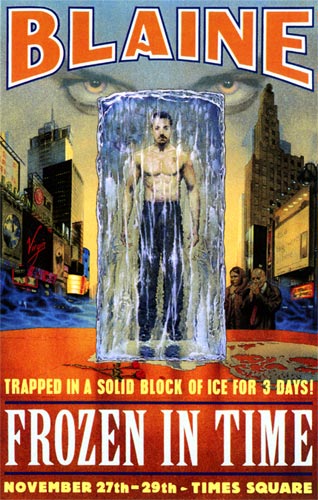
Here, for example, is a poster created to promote David Blaine's "Frozen in Time" special where he was encased in a block of ice for three days:
And here is a poster for David Copperfield
What is noteworthy about this 2007 poster is that it is entirely about the personality of the performer. It is an acknowledgement that his brand is more powerful than any individual effect in his repertoire. The poster invites the audience to surrender their evening to the artist and, in exchange, he will amaze.
It's not unlike how they advertise movies with posters featuring featuring the face of the lead actor, or, from more than a century before, when "Buffalo Bill" Cody toured with his Wild West Show:

Promotion plays a big part in framing the audience's expectations of a performer.
Today, with access to a tidal wave of information, audience members can seek out all kinds of information about magicians including clips of their performances, appearances on TV chat shows and a career's worth of interviews. (A search on the terms "David Copperfield, magician" yielded 738,000 hits including information on his performances at the MGM resort in Las Vegas and clips of some of his signature effects such as making the Statue of Liberty Disappear.)
A few minutes online and any audience member can have a pretty good sense of what to expect from the performer.
This new world of audience awareness offers both challenges and opportunities to the performer. the challenge for the performer is to keep innovating: developing new material and new presentations; the opportunity is to subvert those expectations and show the audience things they did not expect and have not seen before.
In an earlier post, I wrote about Cardini and how his act was largely decimated by a single TV appearance. He had an act that he developed over the course of a lifetime's work and he made it as perfect as anyone could. Those 9 minutes were how he made his living and when they were gone, once they had been "burned" by a national TV appearance, there was nothing more. He did not have a new act.
Before electronic media and central air conditioning ruled our lives, when magicians toured every year, it was possible to see more clearly how performers built and maintained their brand with their audiences.
Successful magicians used to tour a circuit of theatres each year. Starting in the Fall and ending just as it would get too hot to keep an audience in doors in the late Spring, magicians could be expected to make annual appearances in communities in their territories. In so-doing they were able to develop what would now be called a fanbase. And by having a couple of months off the road each year, they could both repair their existing equipment and also develop new material.
Each visit would bring with it the promise of a mix of new material and old favorites.
In late summer, the performer's advance men would hit the road and talk-up the performer and their "new" show. They would check out the theatres, arrange accommodations and hire bill posters to put up the boss' latest one two and three-sheets. And, just as the train pulled into town carrying the show, the advance man, or "ad man," would be pulling out and headed for the next tour stop.
Posters played an important role in promoting the performer's brand and also in communicating to an audience that might not have been able to read, or who did not understand English. And it is for that reason that the posters of this period were dramatic and very representative of the expectation that the performer was hoping to create.
Here is an image of a poster used by Charles Carter. It is typical of posters used in the first quarter of the 20th century. It carried the performer's name and a representation of a featured illusion for that particular tour. In this case, it was an illusion called "Carter Beats the Devil."
 |
| http://rlv.zcache.com/carter_the_great_vintage_magician_poster-p228676195453656632qzz0_400.jpg From about the same period, here is a poster from Howard Thurston:  |
And, if as would most likely be the case, these posters were all over your community, it would be almost impossible to escape this image. Just as it is difficult to escape many television commercials these days.
Satisfying your curiosity would cost maybe twenty-five cents for a seat in "the gods." And that, as they say, was the name of the game.
You can see many of these same practices in use today.
Here, for example, is a poster created to promote David Blaine's "Frozen in Time" special where he was encased in a block of ice for three days:
 |
| http://images.penguinmagic.com/images/products/original/9046a.jpg |
 |
| http://newsimg.bbc.co.uk/media/images/44191000/jpg/_44191388_copperfield_afp203.jpg |
It's not unlike how they advertise movies with posters featuring featuring the face of the lead actor, or, from more than a century before, when "Buffalo Bill" Cody toured with his Wild West Show:
This poster dates from about 1900--about half-way through the 30-year run of Cody's 4-hour travelling extravaganza. For a man whose show was already a household name and whose name was already a household name, what else did he have to say? His audience had already been trained what to expect from these shows.
* * *
The rules have not really changed when it comes to generating interest in an upcoming show or event.
Despite the changes in media, all marketing is social. The goal is to get the potential audience pool curious, expectant and, above all, talking.
"I can't believe he's going to be frozen in a block of ice." "You have to see this guy, he actually flies on stage." "My dad took me to see this guy when I was your age...." "I wonder if he's still doing...." "I hear he's doing all new stuff this year...."
These are the kinds of statements that the performer wants his audience making to themselves and, most importantly, to others. They translate into ticket sales and, once they take their seats, they make the audience more receptive to the performance. It's more nuanced than this, but a successful campaign is a way of pre-qualifying the audience: if they are drawn in by the promotion, they will already have met the performer more than half-way.
Sunday, September 11, 2011
O, for a Muse of Fire
 |
| http://www.criterion.com/films/908-f-for-fake |
 " illusionist, and part-time filmmaker, Orson Welles creates what he descried as a film essay on creativity, deceit, misdirection and storytelling.
Built primarily from unused footage shot for a documentary on art forger Elmyr de Hory, the film features Clifford Irving who was, at the time he was being photographed, in the middle of perpetrating a forgery of his own, the "autobiography" of reclusive billionaire Howard Hughes.
In asides shot in the editing bay--arguably as he was putting the film together--Welles appears almost giddy to have "stumbled" across this mirrors upon mirrors scenario. To their stories he adds his own experience as a faker when he convinced the nation that it was under attack by Martians.
And it is against this backdrop of deception that Welles makes the startling vow right to the camera that, even though the film is about deception and features decievers, he will, for the next hour, tell only the absolute truth.
Despite this seeming like a paradox that Captain Kirk would use to overcome the logic of one of the menacing Star Trek computers,
the audience is lulled into trusting an admittedly untrustworthy guide.
This is the contract that magicians make with their audiences at every performance: pay close attention and I will convince you that everything you know about your world is no longer true. Regardless of the premise of a particular effect, this is the meta trick and it relies less on technique or technology than on the performer.
There is an often-told tale about Jean-Eugene Robert-Houdin in which he is dispatched to north Africa to help put down a rebellion using his magic. His mission was to demonstrate to the Marabout tribesmen that French magic was stronger than theirs. They were unimpressed with parlor tricks, but he gradually upped the stakes to a point where he was able to convince them that he could actually drain the strength from the body of their strongest warrior.
When this story is told--and there are a number of different versions out there--it is often seen through a western cultural bias: how stupid those tribesmen were to be fooled by such a simple principle. That the trick is still being sold suggests that it continues to fool a variety of audiences.
The more important point, it seems to me, is that the effect was presented in a broader context of a whole performance. I don't know anything about Marabout culture, but I am pretty confident that if you picked out the strongest person in the room and then humiliated them with a trick like this, without first contextualizing it as part of a whole series of demonstrations of your power as a magician, that audience member would probably look for an opportunity to demonstrate his strength on you.
By sequencing his material, Robert-Houdin was establishing his character as a powerful wizard. Beginning with simple coin tricks and ending with the bullet catch and the "Light and Heavy Chest," the audience was presented with a portraint of the performer as wizard. It's no surprise then that he would define a magician as an actor playing the part of a magician.
This is another of those Kirk-worthy paradoxes: magic, an art form that is predicated on deceit and trickery, is also dependent upon a measure of "truthiness." The ability of the audience to trust, or believe that they can trust, the performer even as he misrepresents and misdirects is critical to the success of the tricks. This is one of the reasons that the performer's choice of material must align with their on-stage persona, or character. One would not, for example, believe that a performer like The Amazing Johnathan...
would ever be able to present a trick like "Walking through the Great Wall of China."
Copperfield's choice of material supports, and is supported by, his onstage character.
This brings me back to Welles and "F for Fake."
The film is a master class in these ideas. The authority of the performer is established, the premise of the effect is laid out, the audience is artfully and entertainingly misled, the trick is revealed and then the performer disappears in a puff of smoke. And all of this is done despite a context that would tend to promote an heightened atmosphere of mistrust and skepticism.
How is he able to get away with such an audacious trick? He preys on the imagination of the audience. He provides enough of a glimpse behind the curtain to get the audience rationalizing forgery. Elmyr asks how he can be a criminal if so many museums buy his pictures and declare them "authentic." Clifford Irving makes claims to have met with the world's most famous recluse, believing that he will not appear in public to refute the claims. We watch Elmyr draw a few simple lines in the style of Modigliani and think that on our worst day, we could do as much. Slowly, but surely, we are on the side of the forgers, the fakers. A powerful combination of empathy, greed, imagination and trust is established. The audience, much like the "all-knowing" art curators, is a co-conspirator in the fakery.
Shakespeare, another great faker, uses a similar portfolio of techniques to engage the audience and get them to ignore the confines of a primitive performance space in order to tell the too-big story of Henry V.
In yet another paradox, I will leave you with my favorite reading of this most theatrical of monologues that comes to us from a film version of the play.
Monday, July 11, 2011
The Secret of Steinmeyer's Origami Box

Because I don't perform magic it is difficult to explain why I have so many decks of cards and a suitcase full of tricks. I suspect at some level it is like if you were John Wayne Gacy and had to explain away the clown costume: it's more than a little creepy.

Part of the reason I don't show people magic tricks is because they don't see them the same way I do. Whereas I might--and I emphasize "might"--be able to execute a classic pass and be totally impressed with that, what the audience will have seen is an uninteresting card trick made all the less interesting because I was staring at my hands the entire time.
After twenty-three years together, I have pretty much exhausted my wife's patience for magic. Her early introduction was my "performing" at family gatherings and the cringe-inducing response she had to that tough audience has carried forward. She thinks it's cute that I have a hobby and a good thing that I'm not bothering anyone, least of all her.
There have been instances, however, when she has seen an effect that has overwhelmed her cringe reflex and has registered as artistic or just plain pretty.
One such effect is "Origami Box" designed by Jim Steinmeyer.
On paper, the effect is simplicity itself: the assistant gets into a box and the magician folds the box on itself to an impossibly small size and then, to prove that there is no place for her to hide, he plunges a sword through the center of the box. The sword is removed, the box unfolded and the assistant emerges unscathed.
What takes this effect beyond the realm of the usual assistant-mutilating tricks favored by illusionists is the simplicity of its procedure. I have no way of knowing what's involved for the assistant, but to the audience there is folding and there is unfolding. Much like the artform from which the illusion takes its name, the power comes from simple elements being combined in an artful way. Whereas you and I might just see a piece of paper, an origami artist
 can see a swan, or a crane, or even complex shapes. As audience we see a small box, but to the magician it's large enough to hold his assistant.
I can remember seeing an artist paint a cherry blossom with a few broad gestures and a couple of colors. There was no sketching, no recourse to reference works; none of the self-consciousness that has plagued my attempts to sketch. A lifetime of observation translated into a certainty of brushstrokes. And what was remarkable was that there was not one more stroke on the paper than was needed to convey the image.
The first time I saw this trick was just like that.
I believe it was on the Arsenio Hall show. David Copperfield was promoting an upcoming special and he did the trick to the Peter Gabriel's "Mercy Street."
It was beautiful.
To give you an idea of the effect, let me just say that as one of those who knows just enough about magic to be dangerous, I stopped trying to figure it out and was just engrossed in the moment. There has to be a ridiculously obvious explanation--there always is "once you know the secret"--but I don't care. In that piece Steinmeyer and Copperfield had produced a true piece of art. The method, the magician, the materials and the music took me out of my skeptical self and back to that place that could believe in real magic.
I have written elsewhere of magic as storytelling. Copperfield's presentation of Steinmeyer's effect is a perfect example of this and what is most impressive is that it holds up after multiple viewings. It's so well made that I don't care how it's made.
In the age of YouTube, it is possible to find clips of the illusion being performed by all manner of illusionists, including Copperfield, and what the non-Copperfield versions share in common is that they fail to understand the story of the effect.
I can recall seeing video of the effect being performed not for its poetry, but for time. It seemed to me that the magician and his assistant were trying to see how quickly they could get it done before moving on to the next piece. In their hands it was no different than a magician plucking a card out of the air. I have also seen clips of performers who try to ape Copperfield's presentation and they always fall short. It seems as though they purchased the effect because it met some offstage criterion such as it fit in their truck, or their budget, and beyond that they have no special connection to it.
Sometime after that first viewing, we went to see a live Copperfield show. When the time came for him to do the illusion I recall poking my spouse and saying something like "this is pretty." After the show, that was the piece that she talked about. She was impressed: not easily accomplished when it comes to magic.
I guess it's not that in that moment she saw magic the way that I do--as a world of secrets--but that I was able to see it like a civilian once again. And that, like the illusion itself, is a pretty good trick.
Subscribe to:
Posts (Atom)