Showing posts with label Cardini. Show all posts

Sunday, November 6, 2011

Managing Expectations

In our last meeting, I wrote about old theatres and how they created expectations for the audience and, because I had a limited amount of time to devote to writing that day, I teased a follow-on piece on how performers can manage the expectations of their audiences.
Promotion plays a big part in framing the audience's expectations of a performer.

Today, with access to a tidal wave of information, audience members can seek out all kinds of information about magicians including clips of their performances, appearances on TV chat shows and a career's worth of interviews.  (A search on the terms "David Copperfield, magician" yielded 738,000 hits including information on his performances at the MGM resort in Las Vegas and clips of some of his signature effects such as making the Statue of Liberty Disappear.)

A few minutes online and any audience member can have a pretty good sense of what to expect from the performer.

This new world of audience awareness offers both challenges and opportunities to the performer.  the challenge for the performer is to keep innovating:  developing new material and new presentations; the opportunity is to subvert those expectations and show the audience things they did not expect and have not seen before.

In an earlier post, I wrote about Cardini and how his act was largely decimated by a single TV appearance.  He had an act that he developed over the course of a lifetime's work and he made it as perfect as anyone could.  Those 9 minutes were how he made his living and when they were gone, once they had been "burned" by a national TV appearance, there was nothing more.  He did not have a new act.

Before electronic media and central air conditioning ruled our lives, when magicians toured every year, it was possible to see more clearly how performers built and maintained their brand with their audiences.

Successful magicians used to tour a circuit of theatres each year.  Starting in the Fall and ending just as it would get too hot to keep an audience in doors in the late Spring, magicians could be expected to make annual appearances in communities in their territories.  In so-doing they were able to develop what would now be called a fanbase.  And by having a couple of months off the road each year, they could both repair their existing equipment and also develop new material.

Each visit would bring with it the promise of a mix of new material and old favorites.

In late summer, the performer's advance men would hit the road and talk-up the performer and their "new" show.  They would check out the theatres, arrange accommodations and hire bill posters to put up the boss' latest one two and three-sheets.  And, just as the train pulled into town carrying the show, the advance man, or "ad man," would be pulling out and headed for the next tour stop.

Posters played an important role in promoting the performer's brand and also in communicating to an audience that might not have been able to read, or who did not understand English.  And it is for that reason that the posters of this period were dramatic and very representative of the expectation that the performer was hoping to create.

Here is an image of a poster used by Charles Carter.  It is typical of posters used in the first quarter of the 20th century.  It carried the performer's name and a representation of a featured illusion for that particular tour.  In this case, it was an illusion called "Carter Beats the Devil."

http://rlv.zcache.com/carter_the_great_vintage_magician_poster-p228676195453656632qzz0_400.jpg

From about the same period, here is a poster from Howard Thurston:


The ad is almost perfect.  "Thurston," the familiar name, is shown on a horse being hoisted aloft by four guys dressed like ushers.  Even if you can't read, you know right away that this is unusual and your curiosity is piqued.  What happens next?  Why is he wearing those clothes?

And, if as would most likely be the case, these posters were all over your community, it would be almost impossible to escape this image.  Just as it is difficult to escape many television commercials these days.

Satisfying your curiosity would cost maybe twenty-five cents for a seat in "the gods."  And that, as they say, was the name of the game.

You can see many of these same practices in use today.

Here, for example, is a poster created to promote David Blaine's "Frozen in Time" special where he was encased in a block of ice for three days:
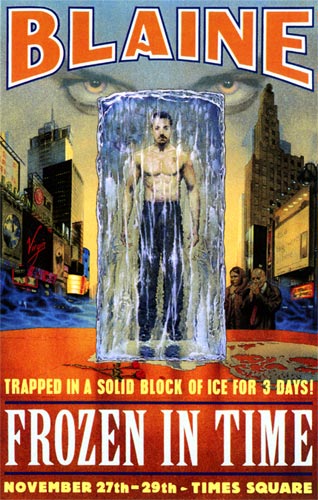

http://images.penguinmagic.com/images/products/original/9046a.jpg
And here is a poster for David Copperfield

http://newsimg.bbc.co.uk/media/images/44191000/jpg/_44191388_copperfield_afp203.jpg
What is noteworthy about this 2007 poster is that it is entirely about the personality of the performer.  It is an acknowledgement that his brand is more powerful than any individual effect in his repertoire.  The poster invites the audience to surrender their evening to the artist and, in exchange, he will amaze.

It's not unlike how they advertise movies with posters featuring featuring the face of the lead actor, or, from more than a century before, when "Buffalo Bill" Cody toured with his Wild West Show:


This poster dates from about 1900--about half-way through the 30-year run of Cody's 4-hour travelling extravaganza.  For a man whose show was already a household name and whose name was already a household name, what else did he have to say?  His audience had already been trained what to expect from these shows.

* * *

The rules have not really changed when it comes to generating interest in an upcoming show or event. 

Despite the changes in media, all marketing is social.  The goal is to get the potential audience pool curious, expectant and, above all, talking. 

"I can't believe he's going to be frozen in a block of ice."  "You have to see this guy, he actually flies on stage."  "My dad took me to see this guy when I was your age...."  "I wonder if he's still doing...."  "I hear he's doing all new stuff this year...."

These are the kinds of statements that the performer wants his audience making to themselves and, most importantly, to others.  They translate into ticket sales and, once they take their seats, they make the audience more receptive to the performance.  It's more nuanced than this, but a successful campaign is a way of pre-qualifying the audience:  if they are drawn in by the promotion, they will already have met the performer more than half-way.

Saturday, July 23, 2011

Passing


Sleight of hand artists use a number of benchmarks to measure their skill level in comparison to their peers.  These benchmarks are moves that become the building blocks upon which much of their repertoire is built.

One such move is the Palm.  This is where the performer conceals a coin, card, or other small object in their hand while it continues to appear empty.

Another foundational move is the Force.  This is a series of actions and equivocations designed to make certain the spectator takes the card that the performer intends.

The high water mark for card workers is the Pass.

This move can take a variety of forms, but the end result is that after a spectator returns their chosen card to the middle of the deck, the performer secretly cuts the cards at that point delivering the chosen card to the top, or bottom, of the deck.  Once the card is delivered to the desired position, the performer can do all manner of additional covert operations before revealing its identity to the audience.

Cutting the cards is a simple enough action:  taking a stack off the top and putting it under the remaining cards.  Doing it covertly can produce some very complex choreography which must appear both innocent and perfectly natural.

The Pass is such a badge of honor that its complexity in service of innocence becomes the measure of its value.  Taking a group of cards off the top, laying them to one side and then stacking all remaining cards on top of the first pile is a low-complexity, low-skill move and something that magicians make civilians do all the time.  Being able to have a selected card returned to a fanned spread and, in the process of closing the fan, cutting the cards so the selection is now on top is more complex and more valued.  This perhaps explains why there are so many variations.  While some may have been devised to suit the needs of specific plots, most would seem to be developed as personal statements and expressions of skill. In my own case, learning the Pass has become important to me and my mildly arthritic fingers precisely because it is a calling card to magic's next level.

I have no aspirations to being a performer, but being able to do a Pass means that you have put the time in and are ready to put down the crutches of trick cards and self-working effects and make your own magic.  As I have written elsewhere, if pressed to present a trick, I default to my self-working, gimmicked roots, but it seems undeniably attractive to try and get a visa to the land of the "real work."

I have a video in my collection by the great Tony Giorgio who has been an actor and authority on advantage play in games of chance.  He has had a semi-regular column in Genii (The Conjuror's Magazine) wherein he writes about the demimonde of sharpsters and mechanics and where, if at all, their world overlaps with magicians.

In this video,
The Ultimate Work, Giorgio demonstrates various moves used by gamblers to overcome the house advantage in card games.  These are not fancy flourishes, but rather moves that are designed to appear perfectly in keeping with normal card table activities.  He maintains that it is at the card table, with money on the line, that moves, any moves, are subject to the greatest scrutiny.  These are conditions described as "under fire" and are the crucible in which real cardmen are forged.

The video was shot with Giorgio in his early eighties and not nearly as smooth as he must have been in his prime, but what is undeniable is his technique and his philosophy.  At one point he talks about techniques for holding out cards until they can be used to maximum advantage, i.e. to make a pair into three of a kind, or to finish out a flush.

For anyone who has ever seen a western with gambling cheats, they have seen a holdout machine.  These are most typically shown as having a series of inter-locked scissors-style arms that can extend and retract in the gambler's sleeve delivering the needed cards when needed. Giorgio demonstrates his ability to accomplish the same effect without the hardware.  And, for the most part, that's a club you can't get into if you're still doing the 21 Card Trick

But wanting to learn the Pass is only the starting point.  You must also decide which one.  There's the Classic Pass, the Bluff Pass, the Half Pass, the Spread Pass, the Dribble Pass, the Nowhere Pass, the Invisible Pass and untold others each with personal variations and subtleties.

It's reasonable to assume that it will not be sufficient to just master one of these.  As I say, to be invisible, the Pass has to pass unnoticed at a time when your spectator is "burning your hands" with their eyes.

And some effects may require multiple uses of the Pass and it is a truism in magic that you should never do the same move the same way for the same audience.  More than once for repetition is the most reliable route to discovery.

You can easily see how study of this one move might become all-consuming.

But mastery of this, or any other skill, is the price of admission to the subsequent levels of challenge and acceptance in any arena.  People don't take you seriously if you stay on the bunny hill, or shallow end, or the putting green.


The above video is of master manipulator Cardini who is said to have practiced his sleight of hand magic in the trenches of World War I where it was so cold that he had to learn his moves with gloves on. After the war, he developed a pitch-perfect ten minute vaudeville act that was his bread and butter for decades.

The video comes from a 1957 appearance where he did his entire act. The television audience in those days was much more homogeneous and so a performer could reach tens of millions of homes in a single evening. In this one performance, Cardini reached more people than he had in all his years on the stage. Despite the masterful technique and the elegance of his presentation, perhaps his greatest trick performed that night was the transformation of his act from "featured" to "formerly featured." The next day, his act wasn't fresh any more. Everyone had seen it.

That's a show business story: a performer spends his entire career perfecting ten minutes and, overnight, he has to start over again if he wants to keep working. Now, I'm certain there's more to this than I have outlined, but it's a story that magicians repeat to one another as a cautionary tale.

Learning a move like the Pass is to use the same bowling shoes as the greats like Cardini. It is to connect to the giants of the art and get a visceral sense of what it takes to be a master.