
Our
basement floods periodically. It's not that bad, just enough to
remind us that we have too much stuff. Like the character count on
Twitter, it forces us into an economy, a precision, in what we choose
to keep. We've had the plumbers in to clean out the drains, but
that's like buying storage bins to “organize” your stuff: it
doesn't reduce the problem, merely postpones it.
The
flooding creates opportunities to discover and uncover items that
have become fossilized in the various strata of our accumulation.
Removing the sodden and the moldy invariably uncovers items acquired
long ago, but lost to time. I might remember buying a book, or a CD,
but, once home, it would be almost impossible to find it. I long ago
learned to not even try and look for them, but to wait until, quite
literally, they resurface.
Only
rarely do I brave the geology of stuff in our basement to purposely
look for something. It's just not worth it and, besides, spring will
be here soon, the water will rise, and some decisions will be forced
upon us.
The
other day, I did go into the basement to look for a particular
suitcase.
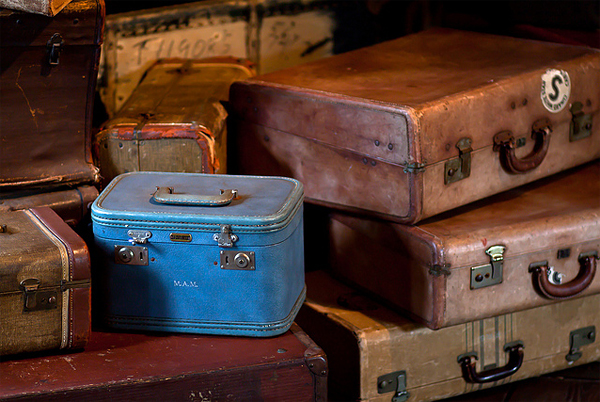
It
was a real suitcase and not the overwrought plastic bags that pass
for luggage these days. It was from a set that, at one time,
included a larger brother and a make-up case. It was light brown,
hard-sided and edged in a leather banding that, I suppose, was meant
to evoke the strapping on the old steamer trunks from the days when
traveling was an end in itself and not just a protracted detention on
the way to some place else.
The
case I was looking for was maybe eighteen inches by thirty inches and
perhaps six inches thick at its widest end. It had two metal-plated
catches with large, round buttons that you slid to the outside in
order release the hasp. The inside was covered in a red wine-colored
synthetic fabric and there were pockets along three sides of the
bottom section—ne of which was lined in plastic—and there was a
fourth, larger pocket that ran the full width of the underside of the
lid.
The
case had seen better days when it came to me more than forty years
ago. The light brown fabric that had been laminated to the suitcase
was worn in places and the leather banding had separated in several
more.
I
didn't care. To me, it was perfect. Perfect for anyone destined for
a career in show business.
Even
then, perched on the precipice of adolescence, I had seen enough old
movies to know that show people were different, like no people you
know and that their luggage was beat-up and covered with shipping
stickers and labels from the road.

I
was going to be a magician like my heroes Doug Henning, Mark Wilson
and Houdini, and my luggage needed to look the part.
I
was embarking on a career in show business and a traveling performer
needed a case to carry the tools of his trade.
Now,
when I look into this suitcase I see an dd assortment of envelopes,
card boxes, random strands of rope and brightly colored pieces of
plastic. But then, when I was still destined for stardom, these
same props and the secret bits and pieces in that case were the
bricks that were going to pave my road to being the very best.
I
hearing about an important collection of films that was discovered
not so long ago. The films were not found in an abandoned salt mine,
or buried in permafrost, but in a closet in a government building in
Washington. The collection had become lost because, due to the
neglect brought on by changing fashion, the closet door had swelled
shut and never been repaired.
The
find was significant because it was the only remaining record of a
collection of films that had long been thought lost to time. In
point of fact, the films actually were lost, their nitrate negatives
having long ago turned to dust, but in this closet was a paper print
of every frame of those negatives. The paper prints were a valuable
reminder of what had been lost and a possible path to its
resurrection, provided that one was prepared to invest the time to
convert the prints to negatives and the negatives into new film.

I
thought about that story as I opened my old bag of tricks.
Opening
that suitcase reminded me of the shows I had done, the audiences that
did not share my enthusiasms and that I never seemed to reach.
There
is an old show business maxim about not working with children or
animals. I can tell you from personal experience that when it comes
to doing children's birthday parties, it's almost impossible to tell
the difference.
As
a beginner, I was interested in doing the magic of my heroes, the
kind of stuff I had seen on Ed Sullivan, or the Merv Griffin Show. I
wanted to make canes appear, perform amazing feats with cards and
impossible feats of mindreading. And I had no trouble finding magic
dealers who were happy to sell me the necessary equipment.
On
the other hand, as I would discover, children want visual, direct
magic that makes a mess and, most frequently, makes them feel smarter
than the magician. I was thinking in terms of white tie and tails
and the audiences that were available to me would have been okay with
that so long as I also had big floppy shoes and a clown nose.
I
did the best I could to read up on my magical heroes and those just
beginning to make their name. It seemed as though they had all done
birthday parties and so I guessed this was my trial by fire, my
out-of-town tryout, that would develop my chops and get me ready for
the big time.
My
mom and dad had a pretty extensive social network and were not shy
about putting the word out that I was ready for the next birthday, or
other special event.
My
introduction to magic was as a puzzle that had to be solved.
Apparently, it was possible to turn water into wine and I wanted to
know how it was done and then I wanted to be the guy who spread the
curiosity. I wanted to infect others as I had been infected.
So,
it's a pretty common story: boy sees magic trick, boy finds magic
dealer, boy buys magic trick. It becomes a kind of magical arms
race: each new trick reveals yet more unknown secrets and more
buying. The need to acquire magical secrets becomes like a sickness.
Magic
dealers are eager to welcome young magicians in the same way that
their casino brethren welcome players with a system—with open arms.
I
bought a lot of stuff that I shouldn't have, stuff I could never have
performed—should never have performed. I was doing magic the same
way I told jokes—not because I understood them, or how to tell
them, but because I had read about them somewhere.

I
remember hearing an old Nipsey Russell joke on one of his records. I
have no idea how old I was, but most likely still in elementary
school, and it has stayed with me all these years not because I
understood it, but because I remember the reaction it got and I
wanted some of that. “There was an old woman who lived in a shoe.
She had so many children, she didn't know what to do...apparently.”
Now,
imagine that coming out of the mouth of your favorite eleven-year-old
and you will have some idea of what my magic performances were like.
Being
so focused on the mythology of show business and a misguided
certainty that I was going to play some part in that world, I was
blind to my totally artless performances.
My
audiences weren't.
When
you first start out in magic, especially as a kid, you can count on a
certain amount of good will to get in a little stage time, but if you
are even the least bit interested in learning new tricks, that good
will quickly dissipates. Even your nearest and dearest will
demonstrate surprising amounts of creativity in response to the
question “Wanna see a magic trick?”
I
have this image of chasing my little sister around with a pack of
cards in my hand. It took me a long time to understand what my
sister had grasped intuitively: that magic, at least as performed by
me, was something to be avoided.
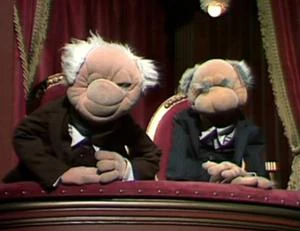
Once
or twice a year, my extended family would gather for some sort of
holiday feast and I was given the opportunity to perform miracles for
their after dinner entertainment.
In
the early years, I was so excited to have a captive audience that I
did not fully appreciate how very different an audience this was and
how I needed to adjust my approach. I thought a performance was a
performance and pretty much did the same material I had done for
birthday parties.
Everything
I know about audiences was learned in performing for relatives.
First,
unlike your immediate family, there is no grace period when
performing for relatives. Even as a child, you don't get any wiggle
room. If I didn't do a good job, and may times even if I did, they
were merciless in their critiques.
I
also learned that audiences are living, breathing, conscious
entities. They think, act, react and can smell fear. If you are
introduced asa comedian than the audience will perceive their
experience of you as funny—they will look for the laugh. If you
are introduced as a magician then the audience will see every action
as a challenge, every trick as a puzzle.
A
good magician structures his material and presentation so that the
audience convinces itself what they are seeing is impossible and they
eventually surrender to the performer.
That's
what a good, experienced, performer does. I, who was neither, chose
another path: abject terror.
In
the presence of abject terror, audiences are like sharks in the
presence of blood. You have their complete attention. They will not
be misdirected. They will be ruthless.
Almost
as one, instead of surrendering to a child-like sense of wonder, they
would transform into real-time play-by-play color commentators
evaluating my performance.
It
is important to note that this audience commentary track, fueled by
much food and more drink, was served up in the form of jokes and
japery.
And
that very particular audience, in addition to being conscious and
fire-breathing, also was very competitive. Almost inadvertently,
there would come a point in these performances when I, in the sleeper
choke-hold of my extended family and struggling to remember the
procedures of a particular trick, would become entirely secondary to
the performance. Before the rabbit would appear, or the chosen card
would appear in an impossible location, my family would become more
interested in seeing who among them could make the funniest comment,
or deliver the most sarcastic praise.
At
some level, I suppose I should be grateful to them because it was a
kind of special forces training in public speaking and, as I got
older, I became better at protecting myself in front of them, but it
did help to drive away any passion for performance. Quite literally,
I was being heckled by audience members between eight and eighty;
that had to mean something.
By
the time I reached high school, I had put away my bag of tricks, but
I never really lost my passion for magic.
For
many years, my interest was, as it had been in the beginning, about
learning how. I loved the idea of learning the secret of how a trick
was done. I was an excellent audience for mass market books about,
or claiming to be about, the secrets of magic. I continued to read
about the popular magicians from the days before television. I
wanted to learn everything I could about how they vanished elephants
and levitated princesses. I wanted to know about what was different
on the other side of the footlights that made such miracles possible.
This
lead me into the first part of my adult life—the time when I had
planned to take the magic world by storm—working well behind those
footlights. I built scenery and crewed shows; working to make the
performers look good.
I
was, I suppose, performing a kind of magic in that I was creating
make-believe spaces for actors and dancers. I learned how to turn
low-grade lumber into period-correct furniture and bargain-basement
paneling into stone.
One
thing was certain, there was a lot less heckling.
To
this day, I'm not sure why I kept that case. I'm certainly never
going to do another birthday party. But neither was I going to miss
magicians when they performed on TV or near my town.
And
I continued to collect secrets.

Everytime
I found myself near a toy store, I would bypass the toy of the minute
and go looking for any magic tricks they might have. This explains
why I have drawers full of specialty decks of cards that claim to
make possible all manner of miracles
I
have a lot of secrets, lots of very special magic cards and yet I
still am a lousy performer.
Not
enough secrets; I must not have known enough secrets.
To
address this “gap,” I went to lectures.
A
magic lecture is not like other lectures. It is no dry recitation of
facts supporting the presenter's perspective on some dark corner of a
given topic. A magic lecture is essentially a private performance by
the presenter—usually a working professional—of effects that used
to be part of their repertoire. And, after each trick, the performer
explains how it was done.
This
was ideal for me in that with each lecture I got an armload of
secrets and a clear road map on how to perform them. It is to my
everlasting frustration that even with that tremendous head-start I
made no improvement as a performer.
I
didn't understand. How could I fail? I saw the performance, I
bought the trick, I had the performer walk me through the secret and
yet, when it would come time to once again play the Viper Room that
was our family gatherings, I was no better off then I had been the
year before.
Perhaps
the lecturers were not as good as I thought.
Perhaps
the problem lay elsewhere....
I
took a long time to consider the problem, to diagnose why I was not
as good as the people I had been watching.
I
immersed myself in the fake magic of my work, closed up my suitcase
and concentrated on an entirely different bag of tricks.
For
many of my adult years my passion for magic was primarily academic.
I appreciated the stagecraft that convinced a television audience
that a railroad car could float and then vanish or that a man could
walk through the Great Wall of China, but I no longer imagined myself
doing either. It was enough to know that the TV guys and I were
using the same tools.
That
kept me going for a long time. Up to maybe ten years ago, I was
content to be a fellow practitioner in an allied field—however
distantly—with a large collection of books and even larger
collection of playing cards.
And
then I came across a book that knit my two worlds together.
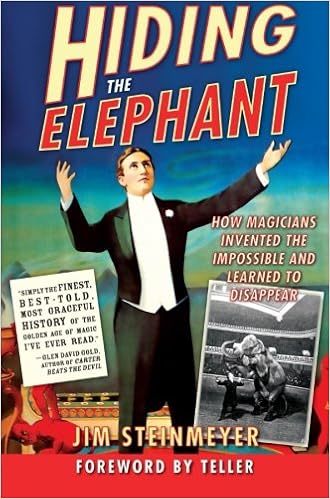
“Hiding
the Elephant” is a popular history of live entertainment from the
late nineteenth and early twentieth centuries written by Jim
Steinmeyer who, among his numerous credits, worked with magician Doug
Henning and designed the Statue of Liberty Vanish for David
Copperfield.
The
book begins with a description of how, in 1919, Harry Houdini made an
elephant disappear from the stage of the Hippodrome in New York City.
From there, he goes back to trace the roots of the technology that
made that particular trick possible.
In
an era when so much of what we see is accomplished by the
photo-realistic manipulation of ones and zeroes, it is difficult to
comprehend how simple mirrors could be used to create similar effects
in front of a live audiences. Furthermore, almost one hundred years
after Houdini and almost one hundred and fifty years after it was
originally created, the same technology thrills audiences daily at
Disney theme parks across the world.
By
and large, the technologies of the theatre are so analog, that it is
difficult to imagine convincing audiences of anything as dramatic as
making an elephant disappear. And yet, the concept has entered the
collective consciousness. Perhaps, it is the scale of the idea that
has stuck, but when you talk about magic, it frequently comes up.
Making rabbits disappear, although a stock image, is rarely performed
and most likely would not be book-worthy but, an elephant....
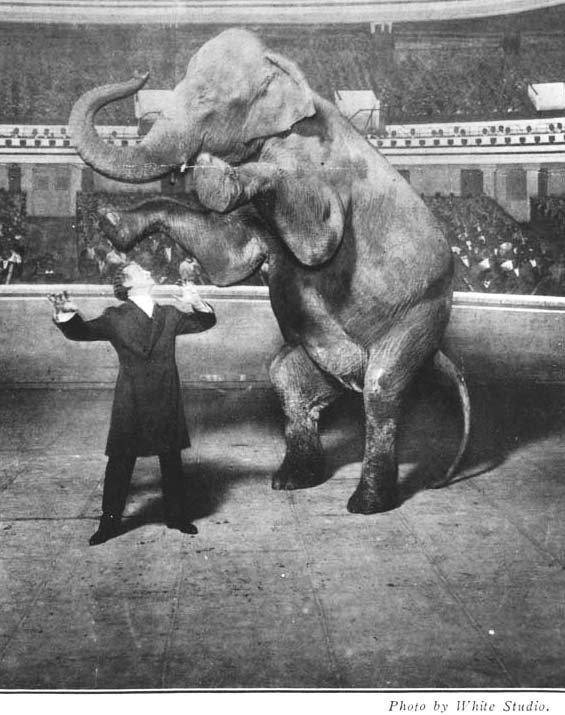
What
was most interesting to me was Steinmeyer's observation that only a
small portion of the theatre's five-thousand patrons could actually
see that the elephant had vanished and that, only by force of will,
was Houdini able to sell the effect to the other eighty percent of
the audience.
Houdini,
though a singular escape artist, was, according to Steinmeyer, a
mediocre magician. I was aspiring to mediocrity, a goal well within
my reach. Here was the bridge between the world of magic and the
world I actually lived in. The audience has to commit to being
fooled, to participate in its own deception.
Not
too long ago, I started going back to lectures.
I
am fortunate to live near enough to where a weekly live webcast
lecture is produced and, in order to have a live audience for the
performer to work with, the producers offer free admission.
Armed
with Steinmeyer's perspective, the experience of watching magic and
magicians is now very different for me. As a kid, I was watching for
technique and presentation cues; when I watch now, I see something
much more complex.
It
is a theatrical experience: there is a performer, an audience, props
and scenery, costumes, sound and, most importantly, a script. Magic
is a designed experience.
Just
as Houdini manipulated those same variables to convince the bulk of
his Hippodrome audience that they had seen something that they had
not, a magician—to be worthy of the title-- has to be more than a
technician using a tool, or a dancer aping a choreography. A
magician has to be an artist blending elements, balancing strength
with weakness; drawing attention to one while diminishing focus on
the others.
The
goal is always the same: to tell a story with an unexpected climax.
Having
the opportunity to see such a variety of performers through this new
lens, it has been fascinating to see the difference between those who
are in love with moves and gimmicks and those who use those tools and
others, to really communicate with the audience.
The
theatre is a collective exercise in creation. The performers provide
clues and hints to help establish the world of the story, but the
audience has to fill in the rest with their imagination. In the same
way that film shows us a series of still images and our brains create
the illusion of movement, the drab colors, peeling wallpaper and the
rough furniture convey a time and place, suggest economic
circumstances and the characters that live there even though everyone
involved in the production—on either side of the footlights—is in
a contemporary performance space for the purpose of talking and
listening to stories.
Another
thing I have learned from returning to lectures is about the history
of the medium and the roots of the art form.
Listening
to magician talk about their work, there are most often links to the
work of others who came before. As in most forms of human endeavor,
revolutions are far less common than evolution. The majority of
what's new is based on, or at least inspired by, the work of others
and when a performer actually acknowledges his influences, it can
serve as a marker of other practitioners worth learning more about.

I
had the good fortune to see Roberto Giobbi, a modern master of
close-up magic. In the course of his lecture, he was asked about his
influences and he mentioned that the work of Frank Lane was worthy of
careful consideration.
I
was hooked.
I
knew nothing about Lane, but if Giobbi—the man who literally wrote
the books on modern card magic—says it's worth checking out, it was
worth checking out. And, like that, I began scouring the Internet,
prowling used book shops and tracking down whatever I could get my
hands on. It's was though I became Jim in Stevenson's Treasure
Island and had just gotten hold of the map.
Add
to that the fact that there was not a lot out there to find and it
became all the more interesting.
To
give you a sense of the scale of my obsession, when I learned that
Lane had written about a piece of magical apparatus called the
folding coin, I not only had to find the work, but I had to get a
coin—and I don't even like coin magic.
I
don't think I fully understood my capacity for obsession until I got
a second chance at magic. I find myself constantly trolling the
auction sites and the used book sites. I am reading the literature
and going to conventions and to lectures.
I've
bought books that I may never read and tricks I know I will never
perform because I don't want to miss a story, or the history, or a
secret.
I
have tried to understand what is different this time around and my
best answer is context.
In
the beginning, when I was 10 and wanting to be a magician, I focused
on the wrong things. Like the kids in those Mickey Rooney-Judy
Garland musicals that put on a show because their parents have a barn
and Jimmy knows music, I thought that because I had a magic wand and
a deck of trick cards that I was a magician. I was looking for a
reaction without understanding what caused it.
With
the benefit of hindsight, and some harsh critics, I have come to
understand that wanting to be a magician and having a distinctive
perspective, a voice--something to say--are very different. I could
repeat the Nipsey Russell joke, but I really couldn't “tell” it
until I was much, much older.
The
same is true about magic: telling the audience to “pick a card”
because it says so in the instructions and inviting them to pick a
card because you want to create an experience that will challenge
their understanding of the world is a distinction that takes a while
to understand.
I
am not sure I understand it yet, but I want to be able to figure it
out.
I
have a sneaking suspicion that the difference is the same one that
keeps some performers honing their craft, while others, like me, pack
their magic away.
As
humans, we are all in the same taxi: the longer the ride, the more
expensive it becomes. When we are young, we want to believe that a
quantity of sugar can turn into a glass full of candy, or that a
rabbit can appear in a demonstrably empty hat. Why not?
It doesn't cost that much, we don't have all that much invested in our journey, but, as the meter keeps on turning, it becomes harder to accept what we are being told, or what we are seeing, no matter how much we might want to. Perhaps this explains why we have places where we go, where it is acceptable to let go, to ignore the meter, rejoin our tribe and decide as a group that the laws of reality, of gravity, of physics maybe do not apply in this singular instance.
It doesn't cost that much, we don't have all that much invested in our journey, but, as the meter keeps on turning, it becomes harder to accept what we are being told, or what we are seeing, no matter how much we might want to. Perhaps this explains why we have places where we go, where it is acceptable to let go, to ignore the meter, rejoin our tribe and decide as a group that the laws of reality, of gravity, of physics maybe do not apply in this singular instance.
Kind
of like the idea of what happens in Vegas stays there. We know it
doesn't, but we want to believe it does, or that it might.
We
know about five senses, but it is clear that we are born with at
least six, the last being inevitability. We know that, sooner or
later, the ride will be over and we will have to settle up with our
driver. Stories and magic suggest alternatives.
For
me, watching the meter roll on and knowing that settlement is coming
makes me acutely aware of the cost of every decision, every action,
or inaction. The possibility of magic, of altering the
inevitability, if only for a moment, is very compelling to me.

I
remember hearing a presentation by J.J. Abrams, a writer and
director, about his interest in magic and an item from the famous
Tannen's Magic Shop in New York City. They used to sell a mystery
magic box. It was a random piece of magic apparatus, sold in a box
with a large question mark on it. Abrams revealed that he still has
his original purchase and he still hasn't opened it. The known
unknown of the box has taken on a power that informs his creative
life.
My
little bag of tricks fulfills much the same purpose for me. This is
what my battered suitcase represents, the possibility to suspend the
inevitable, if only for a moment.
I
know it won't be long, before it comes flooding back.


 can see a
